Since a recent posting concerning the deteriorating health of my mother, there have been further developments. She passed away last month. It is the scene of her final moments that I wish to describe.
I talked about the probably medication errors that brought her to the hospital. Now, we used a different medication to help end her life.
I was called to the hospital by my three siblings, who had been there a while. They wanted to increase her morphine drip, knowing that the increase would likely be the end of her already labored respiration. But they waited for me to arrive first. When I got there, she was on her side, and each breath made her face look like a fish gasping fon land. Her eyes were open, but not seeing. There was no one else in the room. Since my sister is a nurse in that hospital, she could control the rate of the iv drip.
I was rather alarmed. I wanted to better understand what was happening. I know that my sister wanted Mom to be out of pain, but were we killing her?
I spoke up, and asked that question. Everyone was distressed, but we could still have a conversation about what was going on. My sister asked me what I wanted to do, which was difficult to answer. She wasn't being flippant - there she was, in possession of much greater knowledge about the situation than I could hope to have, but she really wanted my opinion. I asked, what was she really dying from - would she be dying anyway, and were we just hastening a process with the morphine, while sparing her pain. She was bleeding internally, and there was no way to access the bleed without invasive surgery, which we had declined to do, since she would not survive the procedure with her co-morbidities.
Sister went ahead and increased the morphine, and within a few minutes, the very loud labored breathing quieted down. Her eyes remained open. I positioned myself seated by her head, my nurse sister to my left. She was talking to Mom constantly, giving reassuring statements which were likely not heard. My other sister and brother were on the other side. Over the course of several minutes, her respiration continued to drop, as well as her heartbeat. Sister mentioned that when her heart rate dripped below 60, her pacemaker would attempt to kick in. It did, creating a short spike on the monitor, but it didn't last. Her vitals continued to drop quickly from there, and then she just stopped all motion. Her eyes remained open, and the rest of the time we were in the room, and we said goodbye, I considered closing her eyes, but did not.
One bizarre moment was yet to occur. We had to get the attending ICU physician to declare her death, so we called the floor nurses to get the doc. It was about 2 am. I watched him stumble toward the room, he walked in, banging his shoulder on the partly open glass door, walked past the four of us, peered over her, turned around and said "well, she's at peace" to nobody in particular. He stumbled out, banging his other shoulder on the same door. No acknowledgement of any of us. Nothing like "Hi, I'm doctor whoever, I'm sorry for your loss.
JMK (nee H) 1928-2007
Sunday, September 30, 2007


Tuesday, September 25, 2007
Social Media Marketing
A new term for me, courtesy of a vendor who will be carrying out this function for my company within a few weeks. It means blog monitoring, in short, both the posts (like this one) that write about your company or product, as well as the feedback the blog postings generate (like all three of mine). I was aware of activity at my company that scrutinized sites like WebMD and the major disease sites like the various Cancer societies, but now we're talking about a bigger rabbit hole.
We'll be jumping into it headfirst, looking for postings for one of our asthma products. Google and Technorati keyword searches, board tracker software, etc.
An anonymous screen name is not enough to warrant action normally for an adverse event report. That's just not a valid, identifiable patient or reporter. But we've made exceptions in the past if the poster describes a serious adverse event that we have a particular interest in for that product.
I'm a little unsure about the value add for this kind of activity. Last Spring, our pro-active monitoring of Cafe Pharma revealed a very embarrassing post by a named individual in our sales force, that compared physician visits by sales reps to grabbing money from a cookie jar. It still made it to Peter Rost's blog, but we did fast damage control by being aware of it that much sooner. Pharma Blogosphere has information about posing as consumers on blogs, but we've never reached that point, and I doubt we will, considering the scowling glances that our legal folks brought to the table, simply at the mention of monitoring sites.
Recent experience is very interesting. For another, more controversial product, we uncovered artificial blogging activity that was an attempt to create business for law firms. One poster would write "I started taking this medicine, and this terrible thing happened!" and the response would be "That happened to me too! I just got a $100,000 settlement for it though. Check it out!" and the whole thing was an elaborate fake. There would be a banner at the bottom for Dewey, Screwum and Howe law offices. We managed to take action, but my readers will be aware that we were (and still are) awash in legal cases.
Speaking of which, I just participated in a review of a regulatory document for a legally challenged product that was hardly a joy to read, as it was all about patient deaths. As I alluded to in a previous post, there are concerns that the legal case overload will throw off our ability to detect genuine safety signals. If our spontaneous caseload normally equals x% of the background "noise" for a condition or event, but the case load for one particular issue skyrockets and clogs our database, our statistical analysis must be reconfigured to handle that, or else a separate analysis is undertaken to discount those legal cases. The latter is what we've actually done. So for this document, the discussion of legal cases was made separate from the rest.
A special shout-out to those of you who let me know you've added my blog to your Google Reader accounts. Let me know if you got this.
We'll be jumping into it headfirst, looking for postings for one of our asthma products. Google and Technorati keyword searches, board tracker software, etc.
An anonymous screen name is not enough to warrant action normally for an adverse event report. That's just not a valid, identifiable patient or reporter. But we've made exceptions in the past if the poster describes a serious adverse event that we have a particular interest in for that product.
I'm a little unsure about the value add for this kind of activity. Last Spring, our pro-active monitoring of Cafe Pharma revealed a very embarrassing post by a named individual in our sales force, that compared physician visits by sales reps to grabbing money from a cookie jar. It still made it to Peter Rost's blog, but we did fast damage control by being aware of it that much sooner. Pharma Blogosphere has information about posing as consumers on blogs, but we've never reached that point, and I doubt we will, considering the scowling glances that our legal folks brought to the table, simply at the mention of monitoring sites.
Recent experience is very interesting. For another, more controversial product, we uncovered artificial blogging activity that was an attempt to create business for law firms. One poster would write "I started taking this medicine, and this terrible thing happened!" and the response would be "That happened to me too! I just got a $100,000 settlement for it though. Check it out!" and the whole thing was an elaborate fake. There would be a banner at the bottom for Dewey, Screwum and Howe law offices. We managed to take action, but my readers will be aware that we were (and still are) awash in legal cases.
Speaking of which, I just participated in a review of a regulatory document for a legally challenged product that was hardly a joy to read, as it was all about patient deaths. As I alluded to in a previous post, there are concerns that the legal case overload will throw off our ability to detect genuine safety signals. If our spontaneous caseload normally equals x% of the background "noise" for a condition or event, but the case load for one particular issue skyrockets and clogs our database, our statistical analysis must be reconfigured to handle that, or else a separate analysis is undertaken to discount those legal cases. The latter is what we've actually done. So for this document, the discussion of legal cases was made separate from the rest.
A special shout-out to those of you who let me know you've added my blog to your Google Reader accounts. Let me know if you got this.
Friday, July 27, 2007
Reflections in a Glassy Eye
How PB's Personal Life
has been affected by medications is not a new topic. I've mentioned personal issues with my wife's medications, for example. Now the subject is PB's mother, the likely victim of a medication error.
Mom was rehabbing a severe hip problem, when the staff at the residential rehab place gave her an injectable anti-coagulant (not heparin - the name escapes me. Long day.) apparently without discontinuing her Coumadin. They also gave it IM instead of in the gut, where it's indicated. A hemorrhage ensued, accompanied by the usual complications of low hemoglobin, hypoxia, etc. A hospital acquired pneumonia followed.
The hemorrhage was stopped, and Mom recently returned to a different rehab place, to resume treating the underlying mobility problem. I might add that she has unbelievable insurance coverage, thanks to Dad's employment at another Big Pharma company, which ended in 1983. She pays the first $500 out of pocket for anything - docs, meds, whatever, and nothing else after. Not a dime. Can anybody beat that? I can't.
Since being in the new place for a few days, Mom has been "out of it" - glassy eyed, can't find the right words while speaking, and memory loss. This was a very sharp 79 year old woman who was taking college classes last Fall. There are a few different possible reasons for this - her hemorrhage trauma and associated blood problems may have caused some damage to her brain, she has had poor blood oxygen off and on, and her pneumonia continues, but you wouldn't know it without an x-ray. PB also found out about another possible cause - she started Zoloft at about the same time. I need to research possible adverse effects of that SSRI.
Anyway, what drove me to post all this was the reaction I had today from a visit with her.
People visit their elderly parents for a variety of reasons. They are dutiful, the visits are good for the patients, etc. I have a 96 year old in-law who is visited regularly, which is wonderful, but it's not for the sparkling conversation. PB visits Mom because she is an intelligent and interesting conversationalist. Today was very different. It felt like the dutiful visit from the son with all the conversation in one direction, while she stared into the middle distance, smiled and nodded, with no other reply. This was disturbing enough, but when I spoke to staff members about this, they seemed all too eager to dismiss it with simple explanations. It's the meds, or the PT has her tired. Sounds fine, but it's BS. She's been on meds harder than anything you can buy on the street, and was never like this. She's had terrible arthritis for over 30 years which has worn out her body, and was never like this. She wasn't like this two weeks ago. But the staff doesn't know any of that, and frankly, everyone else whom they care for on this floor is in much the same zombie state. So why should they be concerned about the mental condition of a woman they don't know anything about?
As I sat with her during lunch today, I looked around at the 20 or so other residents, and it occurred to me how odd it is that so many people, with nothing else in common besides their age and infirmity, could act so completely identical to each other. What I'm saying is that every one of these people had some kind of personality at one time - there were former jocks, geeks, princesses, whatever, sitting in that room today, and if you subtracted 60 or so years from all of them, that would have been evident. But today they are all identical, with the same stare, no conversation, nothing at all to differentiate them except the color of their clothes.
I've been in a place populated by people in a worse state, who are experiencing dementia, and I noticed that an old personality re-emerges sometimes in that stage. Bullying, crying, and other highly emotional states come flying back to these folks when their minds lose a grip on reality.
But today, my mother was one of the starers, and it scared me to death. This is not who she is. I'm not ready to lose her mind, or to visit her out of a sense of duty. This sounds terribly crass of me, I know. If her brain was indeed damaged, than there may be no recourse. But when she did speak to me, there was fear in her glassy eyes too, because she know exactly what she's lost. She knows she wasn't like this a couple of weeks ago, and she doesn't know if she'll ever get her mind back.
A shout-out to my brother and sisters who live much closer to Mom than I, and have been such excellent advocates for her, especially A____. She's a nurse who is making sure the staff and the doctors know that something is terribly wrong with our mother's mental state, that this is NOT normal, and needs to be investigated, not explained away. I apologize heartily for every time I ever called you a bitch, dear sister.
has been affected by medications is not a new topic. I've mentioned personal issues with my wife's medications, for example. Now the subject is PB's mother, the likely victim of a medication error.
Mom was rehabbing a severe hip problem, when the staff at the residential rehab place gave her an injectable anti-coagulant (not heparin - the name escapes me. Long day.) apparently without discontinuing her Coumadin. They also gave it IM instead of in the gut, where it's indicated. A hemorrhage ensued, accompanied by the usual complications of low hemoglobin, hypoxia, etc. A hospital acquired pneumonia followed.
The hemorrhage was stopped, and Mom recently returned to a different rehab place, to resume treating the underlying mobility problem. I might add that she has unbelievable insurance coverage, thanks to Dad's employment at another Big Pharma company, which ended in 1983. She pays the first $500 out of pocket for anything - docs, meds, whatever, and nothing else after. Not a dime. Can anybody beat that? I can't.
Since being in the new place for a few days, Mom has been "out of it" - glassy eyed, can't find the right words while speaking, and memory loss. This was a very sharp 79 year old woman who was taking college classes last Fall. There are a few different possible reasons for this - her hemorrhage trauma and associated blood problems may have caused some damage to her brain, she has had poor blood oxygen off and on, and her pneumonia continues, but you wouldn't know it without an x-ray. PB also found out about another possible cause - she started Zoloft at about the same time. I need to research possible adverse effects of that SSRI.
Anyway, what drove me to post all this was the reaction I had today from a visit with her.
People visit their elderly parents for a variety of reasons. They are dutiful, the visits are good for the patients, etc. I have a 96 year old in-law who is visited regularly, which is wonderful, but it's not for the sparkling conversation. PB visits Mom because she is an intelligent and interesting conversationalist. Today was very different. It felt like the dutiful visit from the son with all the conversation in one direction, while she stared into the middle distance, smiled and nodded, with no other reply. This was disturbing enough, but when I spoke to staff members about this, they seemed all too eager to dismiss it with simple explanations. It's the meds, or the PT has her tired. Sounds fine, but it's BS. She's been on meds harder than anything you can buy on the street, and was never like this. She's had terrible arthritis for over 30 years which has worn out her body, and was never like this. She wasn't like this two weeks ago. But the staff doesn't know any of that, and frankly, everyone else whom they care for on this floor is in much the same zombie state. So why should they be concerned about the mental condition of a woman they don't know anything about?
As I sat with her during lunch today, I looked around at the 20 or so other residents, and it occurred to me how odd it is that so many people, with nothing else in common besides their age and infirmity, could act so completely identical to each other. What I'm saying is that every one of these people had some kind of personality at one time - there were former jocks, geeks, princesses, whatever, sitting in that room today, and if you subtracted 60 or so years from all of them, that would have been evident. But today they are all identical, with the same stare, no conversation, nothing at all to differentiate them except the color of their clothes.
I've been in a place populated by people in a worse state, who are experiencing dementia, and I noticed that an old personality re-emerges sometimes in that stage. Bullying, crying, and other highly emotional states come flying back to these folks when their minds lose a grip on reality.
But today, my mother was one of the starers, and it scared me to death. This is not who she is. I'm not ready to lose her mind, or to visit her out of a sense of duty. This sounds terribly crass of me, I know. If her brain was indeed damaged, than there may be no recourse. But when she did speak to me, there was fear in her glassy eyes too, because she know exactly what she's lost. She knows she wasn't like this a couple of weeks ago, and she doesn't know if she'll ever get her mind back.
A shout-out to my brother and sisters who live much closer to Mom than I, and have been such excellent advocates for her, especially A____. She's a nurse who is making sure the staff and the doctors know that something is terribly wrong with our mother's mental state, that this is NOT normal, and needs to be investigated, not explained away. I apologize heartily for every time I ever called you a bitch, dear sister.
Sunday, March 25, 2007
Phrase of the Day
PB learned a new phrase today, while catching up on George Will columns - "rent-seeking." OK, I've actually heard it before, without necessarily knowing what it meant, and I'm sure you business school types are scoffing at PB's ignorance.
BTW, note the link on the right from the page above for the Pat Sajak columns. Did you know Pat was a columnist? PB is having an enlightening weekend.
Sound like anyone we know?It is not true that businesses, as a matter of principle, want to fend off government regulation. Businesses have a metabolic urge to make money, which is as it should be. But when a compliant government gives them the opportunity to use government regulations to enhance their moneymaking, that metabolic urge will overpower any principles about the virtues of free (from government intervention) enterprise.
BTW, note the link on the right from the page above for the Pat Sajak columns. Did you know Pat was a columnist? PB is having an enlightening weekend.
Saturday, March 17, 2007
March 15 WSJ
By the way, if you can find a copy, pick up last Thursday's Wall Street Journal to read the front page article on cancer drug pricing. You can read a blurb here, in addition to some reader comments. I was considering commenting, but just about everything was said. I might add to the poster ("JIM") who is concerned about the economics knowledge of WSJ readers - Investigate how long it takes Pharmas to recoup that $1 billion investment. Not too long, folks. And how much of that $1 billion is real, how much is NIH, etc.
Friday, March 16, 2007
Face to face
So, we'll be traveling next week up the turnpike to see counterparts from another Big Pharma, negotiating safety data exchange agreements. Or rather, observing the negotiation. This is PB's first face-to-face with another company. Yes it's true - PB is an underachiever, so to speak. I came into this racket late, after wasting a few years with more menial jobs. Now I'm not a youngster anymore, and I'm feeling it.
Anyway, the big legal issue with licensing for us has to do with reporting timelines, and the EU. Volume 9A, the European Commission's guidance document on pharmacovigilance (PV) was published in late January, and the big hit in licensing has to do with individual case handling reports (ICHRs). Specifically, the guidance explicitly states in Part 1, section 4.2, that the reporting clock date is set at "0" whenever the Marketing Authorisation Holder company or any company with a contractual arrangement with the MAH gets information about a adverse event. Ouch. Up until now, our practice has been to consider Day "0" the day when our company gets the report from our licensing partner. The deadline is day 15 - these are calendar days, not working days. So now we have to factor in much shorter data exchange timelines with other companies, and re-negotiate existing agreements.
Unfortunately, we don't have any electronic data exchange with our licensing partners. Our ability to do this is hampered by a lack of shared/compatible data standards and systems, and strained IT budgets. We're faxing and e-mailing case reports back and forth. We're doing this after the case has been entered into our own system, with our own internal timelines. Those internal guideline are geared toward our own company getting the reports in by day 15, not worrying about another company needing to do the same thing. Really, it's substantially shorter than 15 days already, because we've got to make the reports available to our marketing companies around the world, so they can submit the reports (usually a CIOMS) to their regulators.
So now, we have to decide either 1. Rework our individual case handling procedures to shorten our internal timelines, and expect our licensing partners to do the same, or 2. Assign one or the other of the companies to handle all of the reporting duties of a co-marketed drug to all of the regulators around the world, or 3. Share all source materials about adverse events with our partners the day they are received, and trust each party to send reports to their respective parts of the world's regulators
In reverse order, Number 3 is a non-starter, because our two companies could have completely different opinions on a case, if it's regulatory serious, listed with our core data sheet, etc. Then we would have two versions of the same case submitted to agencies, which would be a legal nightmare. We'd also never be able to produce a PSUR with competing cases.
Number 2 above can work fine if we're dealing with another large Pharma with established international reporting. They can do the case handling, submit the IPARs and QLLs to the Europeans for us, etc. The company I'm visiting next week can most likely do all that. But it gets really ugly when you've done a licensing deal with a company that only covers one country, like the US. If your licensing partner in the US is only selling your drug here, they have no reason to submit anything to European regulators. They may not even have the means to do so. And they probably won't tighten their internal timelines to get ICHRs to us quickly, so that we can.
So, we're often stuck with option 1, which is chaos and scrambling, or making exceptions for this or that product received from this or that source. Forget harmonization of processes. Or, my personal favorite variation on option 1, streamline your processes to cut out review times of ICHRs. Just type the case in and send it. This would put our reviewing physicians in a snit, but too bad. My company has too many reviews on an ICHR anyway. We've done some recent benchmarking, finding that other companies are just sending the reports, and worrying about medical review later.
But we know that *others* (Dr Wolfe, big law firms, David Graham at FDA) are scrutinizing our ICHRs, and our goal is to get the MedWatch exactly accurate before they go out the door the first time, being very careful with our wording. Franky, if you read my last couple of posts, it doesn't seem to be making any difference. We're under siege as it is, regardless of what we submit.
Anyway, the big legal issue with licensing for us has to do with reporting timelines, and the EU. Volume 9A, the European Commission's guidance document on pharmacovigilance (PV) was published in late January, and the big hit in licensing has to do with individual case handling reports (ICHRs). Specifically, the guidance explicitly states in Part 1, section 4.2, that the reporting clock date is set at "0" whenever the Marketing Authorisation Holder company or any company with a contractual arrangement with the MAH gets information about a adverse event. Ouch. Up until now, our practice has been to consider Day "0" the day when our company gets the report from our licensing partner. The deadline is day 15 - these are calendar days, not working days. So now we have to factor in much shorter data exchange timelines with other companies, and re-negotiate existing agreements.
Unfortunately, we don't have any electronic data exchange with our licensing partners. Our ability to do this is hampered by a lack of shared/compatible data standards and systems, and strained IT budgets. We're faxing and e-mailing case reports back and forth. We're doing this after the case has been entered into our own system, with our own internal timelines. Those internal guideline are geared toward our own company getting the reports in by day 15, not worrying about another company needing to do the same thing. Really, it's substantially shorter than 15 days already, because we've got to make the reports available to our marketing companies around the world, so they can submit the reports (usually a CIOMS) to their regulators.
So now, we have to decide either 1. Rework our individual case handling procedures to shorten our internal timelines, and expect our licensing partners to do the same, or 2. Assign one or the other of the companies to handle all of the reporting duties of a co-marketed drug to all of the regulators around the world, or 3. Share all source materials about adverse events with our partners the day they are received, and trust each party to send reports to their respective parts of the world's regulators
In reverse order, Number 3 is a non-starter, because our two companies could have completely different opinions on a case, if it's regulatory serious, listed with our core data sheet, etc. Then we would have two versions of the same case submitted to agencies, which would be a legal nightmare. We'd also never be able to produce a PSUR with competing cases.
Number 2 above can work fine if we're dealing with another large Pharma with established international reporting. They can do the case handling, submit the IPARs and QLLs to the Europeans for us, etc. The company I'm visiting next week can most likely do all that. But it gets really ugly when you've done a licensing deal with a company that only covers one country, like the US. If your licensing partner in the US is only selling your drug here, they have no reason to submit anything to European regulators. They may not even have the means to do so. And they probably won't tighten their internal timelines to get ICHRs to us quickly, so that we can.
So, we're often stuck with option 1, which is chaos and scrambling, or making exceptions for this or that product received from this or that source. Forget harmonization of processes. Or, my personal favorite variation on option 1, streamline your processes to cut out review times of ICHRs. Just type the case in and send it. This would put our reviewing physicians in a snit, but too bad. My company has too many reviews on an ICHR anyway. We've done some recent benchmarking, finding that other companies are just sending the reports, and worrying about medical review later.
But we know that *others* (Dr Wolfe, big law firms, David Graham at FDA) are scrutinizing our ICHRs, and our goal is to get the MedWatch exactly accurate before they go out the door the first time, being very careful with our wording. Franky, if you read my last couple of posts, it doesn't seem to be making any difference. We're under siege as it is, regardless of what we submit.
Sunday, March 11, 2007
Not much. What's new with you?
Legions of readers have been asking, so PB, what's been going on with you?
Well, we're happy to say we've conned ever more people into thinking we're doing a good job at work, and we're looking at a promotion within the next few months. There's cutbacks in other parts of the company, so that means that additional justifications have to be made for promotions, new hiring, etc. Really, that means that delays are built into the process, so we don't look so callous to managers who have to let people go. The company can say with some plausible deniability that they are not blatantly ignoring the company's bottom line by promoting PB when others elsewhere are being shown the door.
So, why are some people out the door? Over capacity created by incorrect forecasts, which were made incorrect by some high-profile late stage trial failures. Big ones. A shame - those were the products that actually made us proud to be in this business. They were innovative science, new approaches to unmet needs, etc. They just didn't work, was all. Details, details....
Well, we're happy to say we've conned ever more people into thinking we're doing a good job at work, and we're looking at a promotion within the next few months. There's cutbacks in other parts of the company, so that means that additional justifications have to be made for promotions, new hiring, etc. Really, that means that delays are built into the process, so we don't look so callous to managers who have to let people go. The company can say with some plausible deniability that they are not blatantly ignoring the company's bottom line by promoting PB when others elsewhere are being shown the door.
So, why are some people out the door? Over capacity created by incorrect forecasts, which were made incorrect by some high-profile late stage trial failures. Big ones. A shame - those were the products that actually made us proud to be in this business. They were innovative science, new approaches to unmet needs, etc. They just didn't work, was all. Details, details....
Legal Assault
Ouch - over 1000 adverse event report in the past week and counting, all submitted by law firms for one product of ours. Our drug safety group has been scrambling to get these cases in the database on time, asking overseas offices to assist in the data entry, working weekends, etc. Deadlines will be met, according to the Veep of the department.
The reports for this particular product have been rolling in for about a year. We've got about 8000 total legal reports with named patients. If you've read Grisham's The King of Torts, then you have some idea about how this works. Now I'm seeing it from the other side.
If you Google the brand name of this product, about 3 or 4 of the top 2o hits are for law firms, but almost all of the Sponsored links are for lawyers. It's also under investigation by Pennsylvania for off-label marketing. This is a huge franchise, and we're counting on line extensions to keep sales up for at least 10 more years. It's a shame that a product becomes more well known for the negative news it generrates than any actual good it has done for patients.
We have little advance warning about when to expect discs arriving from a law firm with hundreds or more cases, but we haven't had to cry uncle yet. Still, the resource drain is huge.
The reports for this particular product have been rolling in for about a year. We've got about 8000 total legal reports with named patients. If you've read Grisham's The King of Torts, then you have some idea about how this works. Now I'm seeing it from the other side.
If you Google the brand name of this product, about 3 or 4 of the top 2o hits are for law firms, but almost all of the Sponsored links are for lawyers. It's also under investigation by Pennsylvania for off-label marketing. This is a huge franchise, and we're counting on line extensions to keep sales up for at least 10 more years. It's a shame that a product becomes more well known for the negative news it generrates than any actual good it has done for patients.
We have little advance warning about when to expect discs arriving from a law firm with hundreds or more cases, but we haven't had to cry uncle yet. Still, the resource drain is huge.
Wednesday, November 15, 2006
Ouch - 7000 cases and counting...
I almost forgot I had a blog.
Really. Some intereesting things have happened at work, but I forget to record them here. Busy busy busy. My blogshares are suffering terribly.
"King of Torts" comes to life
Yes, we've certainly received legal complaints based on Adverse Events before. But nothing like we're getting this year, for one particular drug.
A law firm in Massachusetts has sent us 7000 complaints, with individual patient identifiers, for one of our psycho-active drugs. Since each patient is named, that means we have to create a case in our safety database for each one. They are overwhelmingly described as having an unspecified illness, so these cases don't get reported anywhere, unless the patient has died. There's a handful of those. We have no idea how many more are coming.
We have a way of marking these cases in our database, so that they don't skew our statistics, which compare a particular instance of an individual event for a drug versus the background rate in the rest of our database. Basically, our database is a universe of patients, that can be used to find safety signals. Adding 7000+ meaningless cases to the database wouldn't help our statistical analyses.
I have absolutely no idea how we are planning to defend these, since no damages are specified, as far as side effect particulars are concerned. Just unspecified illnesses, wreaking havoc on patients' lives. If they named a particular ailment, it's probably on the label anyway. Then you'd be back to the restatement of torts again - unavoidably unsafe products, with warnings provided. They're going to have to provide specifics at some point. The co-morbidities of this patient population are extensive. I don't think this is going anywhere. Just giving our people busy-work.
This drug in particular was a target previously, because we had something listed on our Japanese label that was not listed anywhere else. Oh, the consternation! How dare we not warn the American people about problems that we are warning the Japanese about! Don't we care about Americans?
This went nowhere, because the Japanese label was mandated by the MHW, against our wishes. We didn't believe the Japanese label claim was justified, and we had the data on our side.
Really. Some intereesting things have happened at work, but I forget to record them here. Busy busy busy. My blogshares are suffering terribly.
"King of Torts" comes to life
Yes, we've certainly received legal complaints based on Adverse Events before. But nothing like we're getting this year, for one particular drug.
A law firm in Massachusetts has sent us 7000 complaints, with individual patient identifiers, for one of our psycho-active drugs. Since each patient is named, that means we have to create a case in our safety database for each one. They are overwhelmingly described as having an unspecified illness, so these cases don't get reported anywhere, unless the patient has died. There's a handful of those. We have no idea how many more are coming.
We have a way of marking these cases in our database, so that they don't skew our statistics, which compare a particular instance of an individual event for a drug versus the background rate in the rest of our database. Basically, our database is a universe of patients, that can be used to find safety signals. Adding 7000+ meaningless cases to the database wouldn't help our statistical analyses.
I have absolutely no idea how we are planning to defend these, since no damages are specified, as far as side effect particulars are concerned. Just unspecified illnesses, wreaking havoc on patients' lives. If they named a particular ailment, it's probably on the label anyway. Then you'd be back to the restatement of torts again - unavoidably unsafe products, with warnings provided. They're going to have to provide specifics at some point. The co-morbidities of this patient population are extensive. I don't think this is going anywhere. Just giving our people busy-work.
This drug in particular was a target previously, because we had something listed on our Japanese label that was not listed anywhere else. Oh, the consternation! How dare we not warn the American people about problems that we are warning the Japanese about! Don't we care about Americans?
This went nowhere, because the Japanese label was mandated by the MHW, against our wishes. We didn't believe the Japanese label claim was justified, and we had the data on our side.
Thursday, June 15, 2006
Critical look at Breastfeeding?
My wife sent me a link to this New York Times article on the benefits of breastfeeding, and rather than just replying with a single word like "Interesting!" I sent her the following paragraphs that reflected my views on unfounded claims:
I am glad that there are actual trials underway totest some of the hypotheses that are claimed as benefits of breast feeding.My wife said that my reply was "worthy of pharmablogger" so I decided to post it here.
I'm always reminded of the assumed benefits of hormone replacement therapy, which were assumed to be true fortwo generations, and how shocked everyone was about two years ago, when they were all completely debunkedby a long-term double blind trial.
I'm not trying to downplay breast feeding at all, but so many claims are now being made (like less fussyeaters?!) without solid proof that the public support for breast feeding may come tumbling down if some of them are disproven, if no evidence of benefits hasbeen proven beyond a doubt. Do you get my point?
People love to read an article about something like fat (that a link between fat and certain cancers believed to exist were debunked by study last year) and then say - "See! I knew it all along! Those 'experts' don't really know anything, do they?" It's a profound anti-intellectual streak that runs through Americans. Get the proof, and don't rely on what you think must certainly be true.
Wednesday, February 22, 2006
The Blogging Irony is Rich!
...And they picked me because of my good looks and charm?!?!
So, here's one of my company's latest initiatives - spinning the blogosphere.
Yes indeedy, my company has hired vendors to monitor disease-related blogs and noticeboards, in order to see what kind of bile is being spewed by consumers, I mean patients!, about our products. And soon, we are hoping to influence some of that discussion. The plan is to hire medical professionals to log on to sites where there is negativity about our products, and try to steer the conversation in a more positive direction. Currently, we are planning to have these hired guns identify themselves as healthcare professionals, but not mention that they are (indirectly) on the company payroll, or connected to us in any way.
This is one of those things that you always suspect is going on in the blogosphere, but it is startling to actually hear that we are going to put it into practice. The net-savvy may catch on to this effort quickly, and identify our guys as company people. I hope so, anyway.
So what's my involvement? I've been asked to help out on a team that will evaluate the regulatory impact of the vendor involvement, specifically from a drug safety perspective. If these vendors are company agents, and one of the medical professionals that we've contracted with reads about an adverse event while participating in a discussion, what should they do? We are choosing to not identify these folks as company agents, at least initially. If they read on a board that product X killed someone's mother, what's the reporting obligation? Does that information constitute a legitimate report, with all of the required elements - identifiable patient, drug, event, and reporter?
The identifiable reporter is the sticking point. An anonymous blogger is arguably not such a reporter, but if I'm chatting with someone, would I have an obligation to ask that blogger to contact me or the company, explaining who I am? That would break the "cover" of our blogger, but good safety reporting should trump, right? If we get an email directed to the company about an adverse event, we record that event in our database, but the report remains "suppressed" unless the reporter also gives us more than just their email address. If we don't get a name or address, we email them back and ask for it. If they reply with that information, the case then becomes part of the database. I believe this is standard industry practice. We need a real name at least.
I'm not sure what our team may recommend. I've certainly browsed websites in the past that discussed my company's products, and even saw people mention what are clearly adverse events, but I never reported them to our safety department. But then, I've never done anything other than read the sites, not participate. Is there a meaningful difference, though? What do you think?
So, here's one of my company's latest initiatives - spinning the blogosphere.
Yes indeedy, my company has hired vendors to monitor disease-related blogs and noticeboards, in order to see what kind of bile is being spewed by consumers, I mean patients!, about our products. And soon, we are hoping to influence some of that discussion. The plan is to hire medical professionals to log on to sites where there is negativity about our products, and try to steer the conversation in a more positive direction. Currently, we are planning to have these hired guns identify themselves as healthcare professionals, but not mention that they are (indirectly) on the company payroll, or connected to us in any way.
This is one of those things that you always suspect is going on in the blogosphere, but it is startling to actually hear that we are going to put it into practice. The net-savvy may catch on to this effort quickly, and identify our guys as company people. I hope so, anyway.
So what's my involvement? I've been asked to help out on a team that will evaluate the regulatory impact of the vendor involvement, specifically from a drug safety perspective. If these vendors are company agents, and one of the medical professionals that we've contracted with reads about an adverse event while participating in a discussion, what should they do? We are choosing to not identify these folks as company agents, at least initially. If they read on a board that product X killed someone's mother, what's the reporting obligation? Does that information constitute a legitimate report, with all of the required elements - identifiable patient, drug, event, and reporter?
The identifiable reporter is the sticking point. An anonymous blogger is arguably not such a reporter, but if I'm chatting with someone, would I have an obligation to ask that blogger to contact me or the company, explaining who I am? That would break the "cover" of our blogger, but good safety reporting should trump, right? If we get an email directed to the company about an adverse event, we record that event in our database, but the report remains "suppressed" unless the reporter also gives us more than just their email address. If we don't get a name or address, we email them back and ask for it. If they reply with that information, the case then becomes part of the database. I believe this is standard industry practice. We need a real name at least.
I'm not sure what our team may recommend. I've certainly browsed websites in the past that discussed my company's products, and even saw people mention what are clearly adverse events, but I never reported them to our safety department. But then, I've never done anything other than read the sites, not participate. Is there a meaningful difference, though? What do you think?
Saturday, December 03, 2005
Feeling holier than thou?
Well, hell yes. That's what this blog is all about, no?
Yeah, I suppose it seems that way at times. But now I'm actually feeling pretty good about the Firm, and I'll explain why.
I recently attended a forum where members of my department gave feedback to management about all sorts of issues, about which our management was found lacking, in one of those bi-annual workplace satisfaction surveys that my company conducts for all employees.
During this forum, I had a sidebar discussion with a physician, about the safety review process at our company. This is where all of our safety data is reviewed annually for each drug, and changes are made to the drug's labeling. He said that our company was the first he's worked at where there was no commercial input in this process. It is left entirely to the safety physicians to determine the contents of the safety sections of the labels. He had worked at four other companies, and singled out Wyeth as one where the sales organization had the largest impact on the safety review process. We have several other Wyeth alumni from the mid 90s, and I asked them how much the sales organization affected the safety group back then. They all just smiled, shook their heads gently, and walked away. I wonder why?
Yeah, I suppose it seems that way at times. But now I'm actually feeling pretty good about the Firm, and I'll explain why.
I recently attended a forum where members of my department gave feedback to management about all sorts of issues, about which our management was found lacking, in one of those bi-annual workplace satisfaction surveys that my company conducts for all employees.
During this forum, I had a sidebar discussion with a physician, about the safety review process at our company. This is where all of our safety data is reviewed annually for each drug, and changes are made to the drug's labeling. He said that our company was the first he's worked at where there was no commercial input in this process. It is left entirely to the safety physicians to determine the contents of the safety sections of the labels. He had worked at four other companies, and singled out Wyeth as one where the sales organization had the largest impact on the safety review process. We have several other Wyeth alumni from the mid 90s, and I asked them how much the sales organization affected the safety group back then. They all just smiled, shook their heads gently, and walked away. I wonder why?
Tuesday, November 01, 2005
Economic models, and how we work
No links, just thoughts
Today, my department received a presentation on a new model for international cooperation and harmonization of processes, raising issues, etc. We have three major sites worldwide in my group, and several satellite sites as well.
Just before this presentation, we were given an overview of the Companies efforts to promote Medicare Part D, by an individual from our government affairs office. All employees are expected to have at least minimal knowledge of the program, in anticipation of questions from family and friends that may come our way. To his credit, he was very upfront about the benefit to patients and the company by having hundreds of different plans compete for patients. Better to have hundreds of formularies to try to influence, than an all or nothing government formulary, was his message.
The contrast between these two presentations was thought-provoking. The Medicare presenter was part of the "commercial" organization, very articulate and polished, with a very persuasive message about the benefit of Part D to our company's bottom line. It's brilliant how patients' needs and the Company's benefits are perfectly aligned in so many issues. It's a great PR strategy, to always appear to be on the side of the patient, whether it be promoting "choice" Medicare coverage, or patient safety from counterfeit drugs (remember all those dying Canadians!) or on many other issues. More on that another day.
But the message about our department operating model was starkly different, in a political/philosophical way. Frankly, it was pure socialism in its design. It was all about centralized planning and control of processes, so groups or sites don't get too independent. It was stressed that we need to know how all the areas are operating, in light of FDA inspections that can occur anywhere in the world.
In a decentralized, capitalistic model of our department, we would all be given our goals for the year for output, and told to reach (or preferably, exceed) them in any way we saw fit, provided we didn't breach any laws. And I could not imagine anyone I work with would support such a model. This is a company and industry with an overwhelming (but not exclusive) alliance with Republicanism. But free market thinking just doesn't exist within my workplace.
Today, my department received a presentation on a new model for international cooperation and harmonization of processes, raising issues, etc. We have three major sites worldwide in my group, and several satellite sites as well.
Just before this presentation, we were given an overview of the Companies efforts to promote Medicare Part D, by an individual from our government affairs office. All employees are expected to have at least minimal knowledge of the program, in anticipation of questions from family and friends that may come our way. To his credit, he was very upfront about the benefit to patients and the company by having hundreds of different plans compete for patients. Better to have hundreds of formularies to try to influence, than an all or nothing government formulary, was his message.
The contrast between these two presentations was thought-provoking. The Medicare presenter was part of the "commercial" organization, very articulate and polished, with a very persuasive message about the benefit of Part D to our company's bottom line. It's brilliant how patients' needs and the Company's benefits are perfectly aligned in so many issues. It's a great PR strategy, to always appear to be on the side of the patient, whether it be promoting "choice" Medicare coverage, or patient safety from counterfeit drugs (remember all those dying Canadians!) or on many other issues. More on that another day.
But the message about our department operating model was starkly different, in a political/philosophical way. Frankly, it was pure socialism in its design. It was all about centralized planning and control of processes, so groups or sites don't get too independent. It was stressed that we need to know how all the areas are operating, in light of FDA inspections that can occur anywhere in the world.
In a decentralized, capitalistic model of our department, we would all be given our goals for the year for output, and told to reach (or preferably, exceed) them in any way we saw fit, provided we didn't breach any laws. And I could not imagine anyone I work with would support such a model. This is a company and industry with an overwhelming (but not exclusive) alliance with Republicanism. But free market thinking just doesn't exist within my workplace.
Friday, October 28, 2005
Stranger than Fiction?
"That's a nasty hack - you better take some medicine for it!"
The Puffington Host already had this, and Sploid picked it up from there, but I don't know if all of my reader(s) would see it there. In short, a guy was hired by PhRMA to write a thriller about adulterated drugs from Canada, poisoned by nasty swarthy types. The plug was pulled, and PhRMA's management claims ignorance about this project, set up by a "lower-level employee who acted without authority." The juicy part at the end of this? The book is coming out anyway, supposedly with a drug company behind the poisoning conspiracy! Bitchin! Pre-order today!
The plot thickens....
A reader asked me about possible plot holes in "The Constant Gardener," and I'll try to reply. How can a company hope to market a drug that quickly maims or kills a number of patients? The answer depends on what the drug is for - how deadly is the disease you're trying to cure? Specifically, in the movie the drug is being used for tuberculosis, and there are hints that the drug just needs "fine-tuning" before it can be submitted to regulatory authorities for approval. This is only conceivable if the "fine-tuning" has to do with finding the optimum dose range for the drug. You can't just muck about with the molecule, adding or removing an atom here or there to make it safer. Not yet, anyway. The closest I've seen to that sort of chemistry is to take an isomer of a drug, and to market it as a different compound, after testing. See this article for a good description, and some examples. An example of a film with an outlandish plot revolving around a bad drug, see "The Fugitive" where a drug ("Provasic" - great name!) to clear out blocked arteries was destroying patient livers. This drug would have been pulled within a few months after launch - it made no sense to hide such deadly effects during the trials, since the costs of pulling the drug off the market, with all the associated lawsuits and bad publicity, would be far more than just cutting your losses during clinical trials, and canceling the program. The truly paranoid just don't get that - we can't hide all the dead bodies, you know.
The Puffington Host already had this, and Sploid picked it up from there, but I don't know if all of my reader(s) would see it there. In short, a guy was hired by PhRMA to write a thriller about adulterated drugs from Canada, poisoned by nasty swarthy types. The plug was pulled, and PhRMA's management claims ignorance about this project, set up by a "lower-level employee who acted without authority." The juicy part at the end of this? The book is coming out anyway, supposedly with a drug company behind the poisoning conspiracy! Bitchin! Pre-order today!
The plot thickens....
A reader asked me about possible plot holes in "The Constant Gardener," and I'll try to reply. How can a company hope to market a drug that quickly maims or kills a number of patients? The answer depends on what the drug is for - how deadly is the disease you're trying to cure? Specifically, in the movie the drug is being used for tuberculosis, and there are hints that the drug just needs "fine-tuning" before it can be submitted to regulatory authorities for approval. This is only conceivable if the "fine-tuning" has to do with finding the optimum dose range for the drug. You can't just muck about with the molecule, adding or removing an atom here or there to make it safer. Not yet, anyway. The closest I've seen to that sort of chemistry is to take an isomer of a drug, and to market it as a different compound, after testing. See this article for a good description, and some examples. An example of a film with an outlandish plot revolving around a bad drug, see "The Fugitive" where a drug ("Provasic" - great name!) to clear out blocked arteries was destroying patient livers. This drug would have been pulled within a few months after launch - it made no sense to hide such deadly effects during the trials, since the costs of pulling the drug off the market, with all the associated lawsuits and bad publicity, would be far more than just cutting your losses during clinical trials, and canceling the program. The truly paranoid just don't get that - we can't hide all the dead bodies, you know.
Wednesday, October 26, 2005
What...Me Worry??
I had to take an annual compliance training courseonline today. It was the first time that I had evernoticed that it referenced bad acts by drug companies. For example, during the discussion of theAnti-kickback statute, it mentioned that "there hadbeen a number of high-profile case of pharmaceuticalcompanies..." who had violated various parts of theact. It also referred to "the corrupting influence ofmoney and gifts to the prescriber." I wonder how manyreps were able to to hear that with a straight face? After all, money and gifts to prescribers were theirbread and butter up until quite recently, andarguably, it still is. How else to bag the attentionof physicians on the go, if not for lunches anddinners? "I think you know my position on free food."- Kevin Costner, "The Upside of Anger"
Be Afraid...Be Very Afraid...of what?
A fabulous article that everyone should read appears in the NY Times today. Relative risk, folks. Thisarticle is for all of you idiots who stop using thesubway because you're afraid of terrorists, andinstead drive to work. Everyone I know needs a crashcourse on the statistics of harm (and lotteries too,but that's a topic for another day). Halloween isalso a good time to visit Snopes.com, not to mentionthe Department of Justice crime statistics. Acolleague of mine said today, "You just can't let kidsgo out trick-or-treating these days, like you couldwhen we were kids." Baloney. If it was safe ageneration ago, it's safe now. Our neighborhoods areno more infested with undesirables than they ever were- it's just that we can find out who they are, thanksto Megan's laws.
Be Afraid...Be Very Afraid...of what?
A fabulous article that everyone should read appears in the NY Times today. Relative risk, folks. Thisarticle is for all of you idiots who stop using thesubway because you're afraid of terrorists, andinstead drive to work. Everyone I know needs a crashcourse on the statistics of harm (and lotteries too,but that's a topic for another day). Halloween isalso a good time to visit Snopes.com, not to mentionthe Department of Justice crime statistics. Acolleague of mine said today, "You just can't let kidsgo out trick-or-treating these days, like you couldwhen we were kids." Baloney. If it was safe ageneration ago, it's safe now. Our neighborhoods areno more infested with undesirables than they ever were- it's just that we can find out who they are, thanksto Megan's laws.
Monday, October 03, 2005
God bless the First Amendment
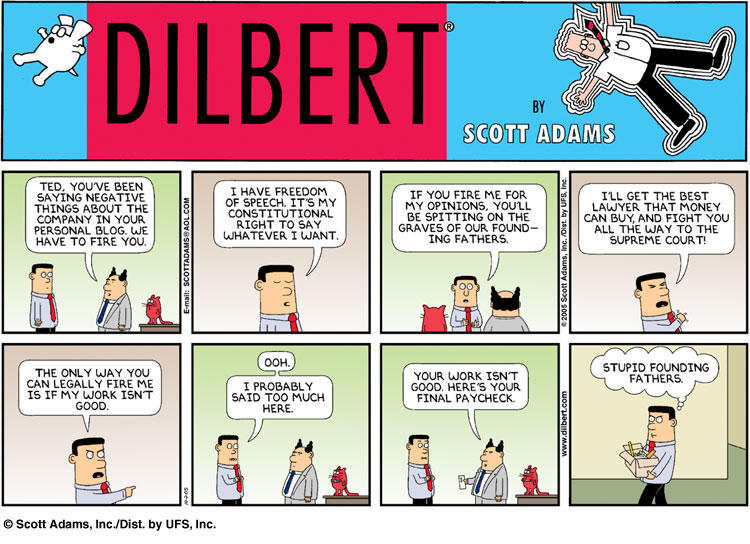
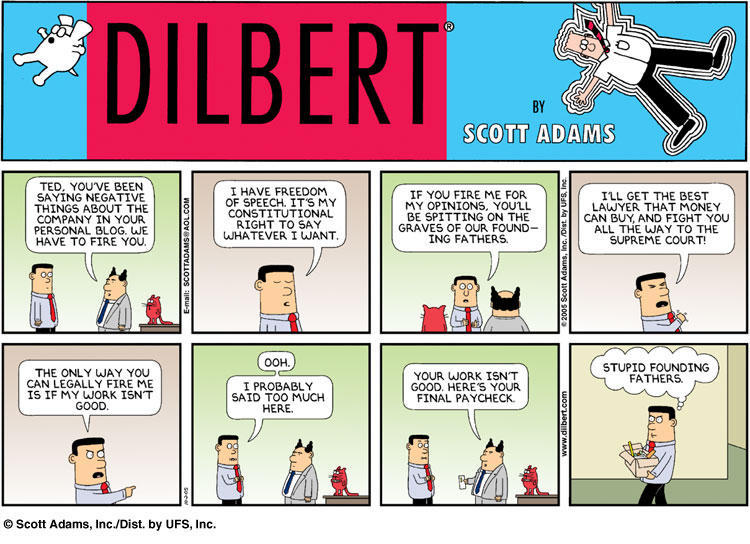
God, I am so screwed....(see above)

But I love my granny....
Merck has tried an interesting line of defense, though suitable only for public consumption. The Philadelphia Inquirer reported yesterday that several key executives have revealed that immediate family members of theirs took Vioxx, in an attempt to dissuade the casual non-thinker that the executives are, in the words of Opus, "Incompetent fibbing poopyheads."
This sort of thing is not admissable as a defense, because it assumes a) that Raymond Gilmartin did not intend to kill his wife, and b) that they didn't decide to take their chances just to avoid the $10 co-pay. In other words, there are lots of reasons someone might choose one drug over another.
Meanwhile, clean arteries.
The AP reports that the cardiologist who treated the plaintiff in the Atlantic City Vioxx trial had clean arteries, in the "top 5%." The stories do not mention who the physician was testifying for - the plaintiff, or the defense. This news indicates that the pool of possible plaintiffs might be smaller than just anyone who had a heart attack while on Vioxx, if they've also got some artery clogging. The goal of the plaintiffs is make Vioxx the proximate cause of the injury, and the evidence shows that it increases the risk of heart attacks, not plaque.
Thursday, September 29, 2005
Guidant is off-course
J & J, Take Me Away!
Guidant has been maufacturing cardiac resynchronization therapy (CRT) units, that stimulate different parts of the heart independently. Recently, they have recalled tens of thousands of units due to short-circuiting problems. See this article for some background. Of course, Guidant isn't new to safety fraud...
Seeding trials?
I don't know much about clinical trials for devices, and how much they differ from drug trials, but in one respect, there seems to be a striking similarity. This New York Times article describes a that Guidant allegedly practiced, using an "evaluation" trial as a method to spur sales. This is right out of the pharmaceutical playbook of old. The company paid physicians to fill out a survey about the devices, $1000 for five forms. Chump change for Guidant, it turns out, since the survey resulted in
Several documents were sent to the Times by someone professing to be an employee of Guidant, but there is no mention of whether there was a protocol for this "evaluation" or whether there was any consultation with IRBs or ethics boards where the participating physicians practiced.
Kick back and read on....
But you can't pay physicians to use your product - that's plainly illegal. So these evaluations have to be considered research to avoid the federal anti-kickback laws. To avoid violating the law, the research purpose for which you pay the physician has to be legitimate. See this presentation to get a better idea of the requirements. To quote:
At first blush, this may seem offensive. Since the industry wrote The Code, it sounds like the industry is therefore determining the law of the land for regulating themselves. I mean, who is supposed to write the laws? Should we have all industries write their own "Codes" and simply have the regulators defer to them?
However, we are persuaded that the PHRMA Code is actually not a bad starting point. In fact, we even heard Jim Sheehan, Associate US Attorney for the Eastern District of PA (Philadelphia) and frequent industry foe, refer to The Code as a good start, that fails only in that it does not address certain areas of conduct. In addition, by having The Code cited in the Federal Register, it makes adoption of this voluntary conduct a necessity to industry. No decent compliance or legal department would allow their sales folks to ignore it.
The Ectasy of Device Manufacturers
After a few more Guidant episodes, perhaps we'll see some similar reactions from the Medical Device Manufacturers Association (MDMA). A comparison between their website and PHRMA's website is instructive. PHRMA practices defensive medicine, knowing that it's an industry under siege. There are all kinds of articles and links to items showing how responsible and honorable they think they are. If we keep the pressure on, perhaps someday they'll live up to their own rhetoric.
Guidant has been maufacturing cardiac resynchronization therapy (CRT) units, that stimulate different parts of the heart independently. Recently, they have recalled tens of thousands of units due to short-circuiting problems. See this article for some background. Of course, Guidant isn't new to safety fraud...
Seeding trials?
I don't know much about clinical trials for devices, and how much they differ from drug trials, but in one respect, there seems to be a striking similarity. This New York Times article describes a that Guidant allegedly practiced, using an "evaluation" trial as a method to spur sales. This is right out of the pharmaceutical playbook of old. The company paid physicians to fill out a survey about the devices, $1000 for five forms. Chump change for Guidant, it turns out, since the survey resulted in
"...>$2 million in new sales with physicians who are not necessarily GuidantThis is what used to be called a seeding trial - using a scientific pretext to generate sales, market share, buzz, or whatever.
friendly. We paid each physician who completed all five surveys $1,000 so
our
total cost was $80,000."
Several documents were sent to the Times by someone professing to be an employee of Guidant, but there is no mention of whether there was a protocol for this "evaluation" or whether there was any consultation with IRBs or ethics boards where the participating physicians practiced.
Kick back and read on....
But you can't pay physicians to use your product - that's plainly illegal. So these evaluations have to be considered research to avoid the federal anti-kickback laws. To avoid violating the law, the research purpose for which you pay the physician has to be legitimate. See this presentation to get a better idea of the requirements. To quote:
"Clinical trials or other research with little scientific value implicate theThe document then references the AMA definition of "Genuine Research Purpose" which you can find here.
federal Anti-kickback Statute and IRS requirements. In addition, clinical
trial proposals that offer inducements to physicians to participate implicate
the federal Anti-kickback Statute."
"How can a physician tell whether there is a "genuine research purpose?"The drug industry has developed, through their trade group PHRMA, a Code for Interactions with Healthcare Professionals. More recently, we have promulgated new standards for clinical trial conduct and communicating their results. The first document was a voluntary code for industry, but has now been incorporated into law, in the sense that the most recent federal regulations on anti-kickback for the drug industry specifically cites the Code for Interactions, considering them to be a minimum standard. We may see similar treatment for the clinical trial standards.
A number of factors can be considered. Signs that a genuine research purpose
exists include the facts that there are (1) a valid study protocol, (2)
recruitment of physicians with appropriate qualifications or expertise, and (3)
recruitment of an appropriate number of physicians in light of the number of
study participants needed for statistical evaluation."
At first blush, this may seem offensive. Since the industry wrote The Code, it sounds like the industry is therefore determining the law of the land for regulating themselves. I mean, who is supposed to write the laws? Should we have all industries write their own "Codes" and simply have the regulators defer to them?
However, we are persuaded that the PHRMA Code is actually not a bad starting point. In fact, we even heard Jim Sheehan, Associate US Attorney for the Eastern District of PA (Philadelphia) and frequent industry foe, refer to The Code as a good start, that fails only in that it does not address certain areas of conduct. In addition, by having The Code cited in the Federal Register, it makes adoption of this voluntary conduct a necessity to industry. No decent compliance or legal department would allow their sales folks to ignore it.
The Ectasy of Device Manufacturers
After a few more Guidant episodes, perhaps we'll see some similar reactions from the Medical Device Manufacturers Association (MDMA). A comparison between their website and PHRMA's website is instructive. PHRMA practices defensive medicine, knowing that it's an industry under siege. There are all kinds of articles and links to items showing how responsible and honorable they think they are. If we keep the pressure on, perhaps someday they'll live up to their own rhetoric.
Tuesday, September 27, 2005
Getting the Label
How depressing.....
is this?. I might just have to take some Prozac.
Getting the Label
OK, let's talk a little about Vioxx. This is a pharmaceutical legal blog, and Vioxx is the big drug litigation story, so you'd think I'd spend more time on this.
Today, there's a telling AP story about Merck officials "getting the label" they wanted for Vioxx. The "label" is the package insert, which contains all the warnings and side effects about a drug, in addition to indications, pharmakinetics, chemistry information, etc. Getting the label you want for a drug is what clinical trials is all about - negotiating with the FDA, based on whatever trial data you have, to avoid warnings and precaution statements as much as possible. Negotiations sounds like a strange word in this setting, but it's what really happens. The drug company argues that there are too many confounding factors that prevent any assignment of causality. For a drug that is generally taken by sick people, this is an easier process for the company, since there is probably a substantial background rate of all kinds of ailments. For a pain drug, you have to consider the patient population who took the drug during the trials. Did they take it for arthritis pain, and are thus probably elderly? They probably take all kinds of other drugs then, with a whole bunch of side effects of their own. The VIGOR study was for rheumatoid arthritis, and if the patients were anything like my mom, they take a pharmacy every day.
In the big continuum that is drug development, before you even have a compound, you have a Target Profile. The profile tells you that you want a drug that does X, does not have side effect Y or Z (that the existing drugs in the therapeutic area have) and has a sales potential of $$$. Thus, you already have the beginnings of the label you want before you even have a compound.
I heard a lecture once from a drug safety physician in my company concerning a particular psychotropic medicine that had a warning about cataracts on the label, based only on animal studies. He had been told that getting rid of that warning was a high priority for drug safety, since it was responsible alone for losing hundreds of millions in sales annually. This was the first time that I heard a dollar figure attached to a safety issue, and it was clear that our marketing folks wanted us to go to the FDA with every argument possible to get rid of that warning.
So, the Merck folks came to the same conclusion about their drug, but they were more successful in their negotiations. They managed to convince the FDA to keep the heart attack information from VIGOR in the "Precautions" section of the label, instead of the "Warnings." This is significant not because the prescribers would notice the warning by themselves (they wouldn't), but rather the helpful competition would be sure to point it out to them, and feature it prominently in their sales materials. Imagine the script for a Pfizer rep - "Celebrex: the ONLY Cox-2 inhibitor without a heart attack warning."
The damning part of all of this is the attitude of the Merck players, as well as their stupid use of email. EMAILS LIVE FOREVER. Write them like they do. And remember - Merck was the most respected drug company in the country. If you asked a focus group about Merck two years ago, you'd get reactions like science, integrity, and so on. The evidence introduced in these trials should forever pierce that veil. How much of Scolnick's emails about VIGOR and the FDA had anything to do with patient well-being, do you suppose?
Tomorrow - Guidant was off-course!
is this?. I might just have to take some Prozac.
Getting the Label
OK, let's talk a little about Vioxx. This is a pharmaceutical legal blog, and Vioxx is the big drug litigation story, so you'd think I'd spend more time on this.
Today, there's a telling AP story about Merck officials "getting the label" they wanted for Vioxx. The "label" is the package insert, which contains all the warnings and side effects about a drug, in addition to indications, pharmakinetics, chemistry information, etc. Getting the label you want for a drug is what clinical trials is all about - negotiating with the FDA, based on whatever trial data you have, to avoid warnings and precaution statements as much as possible. Negotiations sounds like a strange word in this setting, but it's what really happens. The drug company argues that there are too many confounding factors that prevent any assignment of causality. For a drug that is generally taken by sick people, this is an easier process for the company, since there is probably a substantial background rate of all kinds of ailments. For a pain drug, you have to consider the patient population who took the drug during the trials. Did they take it for arthritis pain, and are thus probably elderly? They probably take all kinds of other drugs then, with a whole bunch of side effects of their own. The VIGOR study was for rheumatoid arthritis, and if the patients were anything like my mom, they take a pharmacy every day.
In the big continuum that is drug development, before you even have a compound, you have a Target Profile. The profile tells you that you want a drug that does X, does not have side effect Y or Z (that the existing drugs in the therapeutic area have) and has a sales potential of $$$. Thus, you already have the beginnings of the label you want before you even have a compound.
I heard a lecture once from a drug safety physician in my company concerning a particular psychotropic medicine that had a warning about cataracts on the label, based only on animal studies. He had been told that getting rid of that warning was a high priority for drug safety, since it was responsible alone for losing hundreds of millions in sales annually. This was the first time that I heard a dollar figure attached to a safety issue, and it was clear that our marketing folks wanted us to go to the FDA with every argument possible to get rid of that warning.
So, the Merck folks came to the same conclusion about their drug, but they were more successful in their negotiations. They managed to convince the FDA to keep the heart attack information from VIGOR in the "Precautions" section of the label, instead of the "Warnings." This is significant not because the prescribers would notice the warning by themselves (they wouldn't), but rather the helpful competition would be sure to point it out to them, and feature it prominently in their sales materials. Imagine the script for a Pfizer rep - "Celebrex: the ONLY Cox-2 inhibitor without a heart attack warning."
The damning part of all of this is the attitude of the Merck players, as well as their stupid use of email. EMAILS LIVE FOREVER. Write them like they do. And remember - Merck was the most respected drug company in the country. If you asked a focus group about Merck two years ago, you'd get reactions like science, integrity, and so on. The evidence introduced in these trials should forever pierce that veil. How much of Scolnick's emails about VIGOR and the FDA had anything to do with patient well-being, do you suppose?
Tomorrow - Guidant was off-course!
Thursday, September 22, 2005
See what happens while I'm away??
Obnoxious...must stop...need guidance
Alright, fellow bloggers, how do I get this to stop? I posted about five minutes ago, and my inbox is getting filled with anonymous, clearly automated messages that read something like this:
This is new since August - how can I make it stop?
Alright, fellow bloggers, how do I get this to stop? I posted about five minutes ago, and my inbox is getting filled with anonymous, clearly automated messages that read something like this:
Nice blog. Keep it up. I found this directory on How to drink and stay safe driving . I think it is a good thing that someone is educating us all on How to drink and stay safe driving. Simply PRICELESS!Imagine giving someone you love the opportunity to LIVE by giving them the proper stuff on How to drink and stay safe driving TODAY.
This is new since August - how can I make it stop?
Catching up with the news
Much has happened since my last post. Headlines include the Vioxx verdict, medical device fraud with Guidant, many interesting articles about pricing lawsuits.
But I wanted to focus this evening on issues that are away from the news. One has to do with my criticisms of Medicare Part D and pricing.
A reader criticized my writing about government drug pricing (even accusing me of being a lawyer - what a cheap shot!). He referred me to a book on economics, and briefly explained how government interference in pricing distorts markets.
He was completely correct about the interference of government, but was too limited in his critique of government as a purchasing agent. He reminded me (and I can't believe that I haven't already mentioned this to you) that the Feds require that pharmas sell to them at their lowest price. This is true, and does indeed distort markets. I remember when my company was concerned about their Indigent Patient Program - if we gave away drugs for a few bucks in co-pay to the poor, would that constitute a price? And the TogetherRX program required a waiver from the pricing policy as well, according to my reader.
I am for market pricing - I haven't complained to anyone about the recent gas prices, for example, and found merit in the Wall Street Journal article "In praise of price gouging" or whatever is was called. But there is much more distorting the price of pharmaceuticals than the VA supply schedule. The three largest contributors to price distortion are the patent system for drugs, the regulatory burden of pharmas, and the enormous scientific subsidies they receive.
I'm not going to argue for the abolition of patents or regulations. Hello 1902. No, instead I want to give some perspective to help explain why exempting Medicare Part D from any pricing regulations rubs me the wrong way. The factors that drive up pharma pricing are almost overwhelming, and call for a restraining hand. For example, there is no such thing as a start-up garage-based drug company. Pharma CEOs do not look over their shoulders at lean and hungry start-ups the way Bill Gates has to. Also, you can't look at a drug patent, figure out a quick way to come up with an approved product, and have it on the market in weeks or months. Finally, there are huge gaps between the consumer, the learned intermediary (the doctor) and whoever is paying for the drugs. For most consumer transactions, these three elements are the same.
Think about the impact these elements have on pricing. And think what a small counterweight it is to have regulated pricing for programs paid for with tax dollars.
I've Done This Before...
but I can't help myself. There was a large ad for this item in the coupon section of my Sunday paper a couple of weeks ago, and I almost snarfed my cornflakes. I think I've mentioned before that I know many people who work for McNeil Consumer Products, and it's fun to call them and tease about this. Five years ago, this would never have happened, or so my friends like to believe. Get a real drug company, guys.
Switcheroooooo
You had to know I would mention this item, about the atypical anti-psychotics versus perphenazine. It's important to keep in mind that the headline writers are missing a big point revealed by the studies. While perphenazine performed well, it had a large number of patients who had to discontinue, like the rest of the drugs. So a large armamentarium for anti-psychotics is more important than, say, adding another statin or non-sedating anti-histamine to the market.
By the way, I wouldn't lose too much sleep (har har!) if I worked at AstraZeneca, makers of the maligned Seroquel (maligned in this article, at least). The drug is the market leader in prescriptions, but not sales. Why? Because most of the use is for sedation ("Sleepoquel") at sub-therapeutic doses. Let's just hope they aren't promoting it that way. T'would be bad.
Gardening away
Yep, the movie was awesome. I also watched City of God recently, by the same director, and found it somewhat over-rated. But watch this space in December for shameless promotion of "The Constant Gardner" for Oscar consideration. I cried like three times.
Interesting note - check out this post on essentialdrugs.org, concerning the movie poster. Kind of bizarre. I was struck by the fact that Ralph Fiennes appears with an outstretched arm holding a gun on the movie poster, which never occurs in the film. Also, in the movie's trailer, there's clearly a scene that was set in a snowy area, presumably in Western Canada, where part of the book is set. This is also not in the film.
But I wanted to focus this evening on issues that are away from the news. One has to do with my criticisms of Medicare Part D and pricing.
A reader criticized my writing about government drug pricing (even accusing me of being a lawyer - what a cheap shot!). He referred me to a book on economics, and briefly explained how government interference in pricing distorts markets.
He was completely correct about the interference of government, but was too limited in his critique of government as a purchasing agent. He reminded me (and I can't believe that I haven't already mentioned this to you) that the Feds require that pharmas sell to them at their lowest price. This is true, and does indeed distort markets. I remember when my company was concerned about their Indigent Patient Program - if we gave away drugs for a few bucks in co-pay to the poor, would that constitute a price? And the TogetherRX program required a waiver from the pricing policy as well, according to my reader.
I am for market pricing - I haven't complained to anyone about the recent gas prices, for example, and found merit in the Wall Street Journal article "In praise of price gouging" or whatever is was called. But there is much more distorting the price of pharmaceuticals than the VA supply schedule. The three largest contributors to price distortion are the patent system for drugs, the regulatory burden of pharmas, and the enormous scientific subsidies they receive.
I'm not going to argue for the abolition of patents or regulations. Hello 1902. No, instead I want to give some perspective to help explain why exempting Medicare Part D from any pricing regulations rubs me the wrong way. The factors that drive up pharma pricing are almost overwhelming, and call for a restraining hand. For example, there is no such thing as a start-up garage-based drug company. Pharma CEOs do not look over their shoulders at lean and hungry start-ups the way Bill Gates has to. Also, you can't look at a drug patent, figure out a quick way to come up with an approved product, and have it on the market in weeks or months. Finally, there are huge gaps between the consumer, the learned intermediary (the doctor) and whoever is paying for the drugs. For most consumer transactions, these three elements are the same.
Think about the impact these elements have on pricing. And think what a small counterweight it is to have regulated pricing for programs paid for with tax dollars.
I've Done This Before...
but I can't help myself. There was a large ad for this item in the coupon section of my Sunday paper a couple of weeks ago, and I almost snarfed my cornflakes. I think I've mentioned before that I know many people who work for McNeil Consumer Products, and it's fun to call them and tease about this. Five years ago, this would never have happened, or so my friends like to believe. Get a real drug company, guys.
Switcheroooooo
You had to know I would mention this item, about the atypical anti-psychotics versus perphenazine. It's important to keep in mind that the headline writers are missing a big point revealed by the studies. While perphenazine performed well, it had a large number of patients who had to discontinue, like the rest of the drugs. So a large armamentarium for anti-psychotics is more important than, say, adding another statin or non-sedating anti-histamine to the market.
By the way, I wouldn't lose too much sleep (har har!) if I worked at AstraZeneca, makers of the maligned Seroquel (maligned in this article, at least). The drug is the market leader in prescriptions, but not sales. Why? Because most of the use is for sedation ("Sleepoquel") at sub-therapeutic doses. Let's just hope they aren't promoting it that way. T'would be bad.
Gardening away
Yep, the movie was awesome. I also watched City of God recently, by the same director, and found it somewhat over-rated. But watch this space in December for shameless promotion of "The Constant Gardner" for Oscar consideration. I cried like three times.
Interesting note - check out this post on essentialdrugs.org, concerning the movie poster. Kind of bizarre. I was struck by the fact that Ralph Fiennes appears with an outstretched arm holding a gun on the movie poster, which never occurs in the film. Also, in the movie's trailer, there's clearly a scene that was set in a snowy area, presumably in Western Canada, where part of the book is set. This is also not in the film.
Subscribe to:
Posts (Atom)